
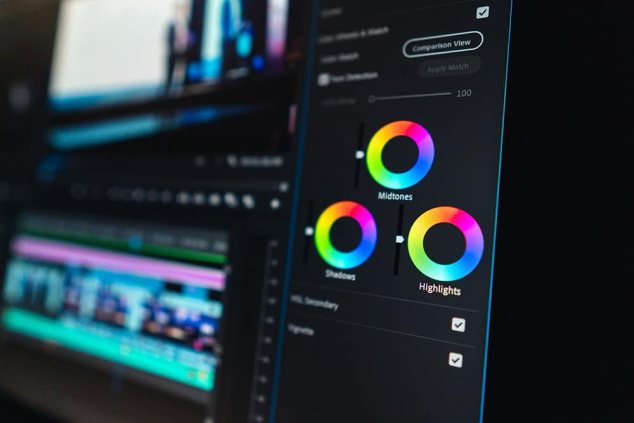
The magic happens in editing. Yes, a lot happens in production ,but a lot more happens in post production. As a video editor you need the best video editing software and techniques to create a great video.
As you should know, colors are very important when it comes to video footage. Using the right color in your film helps in creating the desired ambiance and mood you are trying to set. This is where color correction and grading comes into play.
Everyone loves a film that looks great. That is why you need to pay great attention to your colors when you are editing. That is why we train our video editing students how to color grade and correct effectively.

WHAT IS COLOR GRADING VS COLOR CORRECTION?
Color correction is your first line of action when you start editing. The first thing you need to do is to ensure that all your shots have the same color range, white balance and contrast.
This editing technique is used to make all contrast and color in a film to look unprocessed and natural. It is your duty as an editor to take this unprocessed state and accurately adjust the colors to make it appear more natural.
It also helps you balance colors to ensure that everything appears to be filmed with the same lighting, gadgets and on the same day. The final touches of a film come up in editing.

Color correction vs color grading
While color grading involves the adjustment of colors in a film. It is primarily concerned with artistic decisions made on the video's appearance.
Prior to the advent of digital technology, color grading was also referred to as "color timing," which referred to the physical developing process of film colorization. However, modern computer software makes it possible to produce high-quality color grading effects.
The goal of color grading is to set the tone of the film and ensure that your scenes are aesthetically appealing.
We always tell our students that color correction is important as it is something you will need to do, but you should only color grade if you wish to emphasize a particular topic or feeling in your video.
HOW DIFFERENT TYPES OF COLOR GRADING AFFECT YOUR VIDEO
Color grading as a video editing technique affects your video to a very large extent. It allows you manipulate the colors on your raw file to achieve a desired look. This whole process is done in post-production with editing softwares like Adobe After Effects, Apple Final Cut Pro, and Filmora.
That being said, here are a few ways color grading can affect your videos.
-
A crucial tool for evoking emotions
Different colors tell different stories and emotions. We know black depicts mourning, mystery and even elegance in some cases. Red depicts danger, horror and so on. As a video editor you can use colors appropriately to represent different emotions.
-
Allows you to set a timeline in your video.
Yes, colors depict different timelines or eras. There are different color palettes tied to a specific given period. In the past incandescent lighting was used to capture a lot of videos. Video filmed in the past had a consistent color scheme due to a limited selection of equipment.
Today, there have been a lot of technical upgrades and it is practically impossible to get your hands on vintage cameras to shoot old school. So, your best available option is color grading. Classical movies and antique westerns are frequently associated with warm hues. So, to create a similar effect, use warm color grading or vintage color grading. Hollywood directors, for instance, brown wash their movies to represent historical periods.
• Set a genre with color grading.
Color grading allows you as an editor to express the genre of your film. Horror movies, for instance, emphasize the color red to evoke fear and a sense of dread. Your emphasis is more on the creative result, and depending on how you edit, you can produce various levels of dread.
On the other hand, documentaries' color grading emphasizes color accuracy. As a result, you will use color gradations that highlight the true hues of your subject. Using orange teal color grading, for instance, can better accentuate the skin tones of participants if you are editing a travel vlog.
An example of how color grading will impact your videos is provided above.
COLOR GRADING AND CORRECTION TIPS TO ENHANCE YOUR VIDEOS

-
Get a good system and software
Let's just get this out of the way like we always tell our students at our academy, you need a good system as an editor. Trust us when we say that you don't want your system crashing on you. Is this a tip?? Yes it is! The No 1 tip you need.
There are also a lot of great editing softwares out there depending on your budget. But if you're genuinely considering video editing, you need a good software. You could consider going f
Both Apple's Final Cut and Premiere Pro come equipped with excellent color correction software.
-
Proper exposure is essential
You need to pay attention to exposure when dealing with colors. You can shoot logs depending on the type of camera you have. What this does is to help you keep all your film color and light information and give you flat scenes and shots that are so much easier to color grade and correct.
You can check in advance if your camera can shoot logs, although most cameras can. However, shooting in a log doesn't always solve issues; you still need to check your exposure. Although this could be challenging, just make sure that your shots are well exposed.
-
Avoid becoming overly Lut-Happy
Don't rely on a pre-canned configuration to tell your story; LUTs are wonderful for giving you a head start. After using a LUT to create a base appearance, experiment with your settings to discover the ideal grading effects that hit the appropriate emotional tones for your film.
-
Do proper research
The association of particular colors with particular emotions is supported by a wealth of scientific research. Your color grading's efficacy can be greatly increased by being aware of these correlations. Keep in mind that different civilizations have distinct meanings for different colors.
Red may connote passion in Western culture, but it might symbolize something very different in other cultures.
-
Be gentle with your touches
As much as you want to rush into color grading and correcting, you need to relax a bit. Good color grading is gentle. To indicate that the emotional tone is meant to be depressing, you don't necessarily need to paint the entire picture in black.
Select important components, and consider your grading options carefully.
CONCLUSION
Those are some tips you want to take note of when looking into color grading and color correction. But ultimately, color editing in general is only as good as your imagination allows.
You don't necessarily have to adopt the same procedures for your own projects just because video has been fixed and graded in a certain way in the past. While understanding the fundamentals is helpful, you are free to independently explore the amazing world of color.