
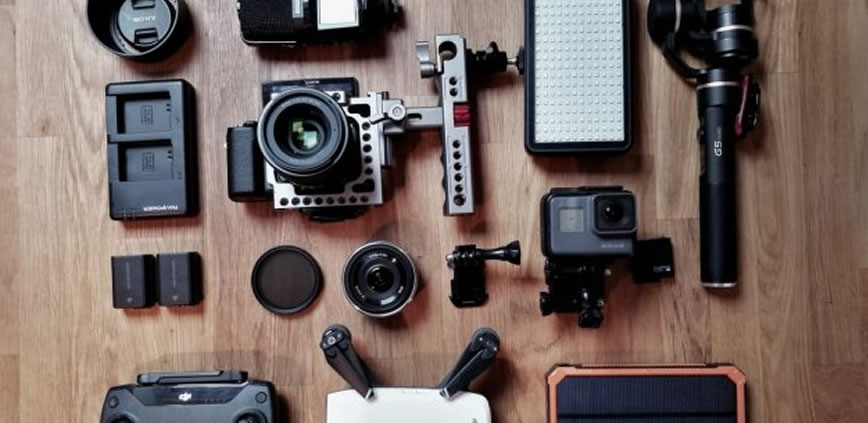
The road to becoming a licensed and qualified filmmaker can be a herculean task at the beginning. Most of the students that attend our cinematography class at our film school in Lagos have had one or two to say on the matter.
However, no matter the challenge you would have a fun and interesting journey in filmmaking. The need for cinematographers is on the rise as the use of video content by businesses has shot up to 49% as opposed to those who don't.
One thing we can guess is that as a newbie, you may not have a lot to spend on gadgets or have enough knowledge about them. In that case, we have got you covered with the 15 filmmaking gears you need!
But hit the road on this list, let's discuss if you should buy or hire these equipment.
SHOULD I BUY FILMMAKING EQUIPMENT OR HIRE?
First of all, there is no right answer to this question, but as the best film academy in Lagos, we can give you some advice on making the right choice.
Let's get this out of the way first, Filmmaking is expensive. As a newbie, it can be a dent in your pocket calculating all the gears you would need as a filmmaker. All you need to know is whatever equipment you purchase is an investment into your future as a filmmaker.
It only gets interesting. When you buy film equipment, you can rent them out when they are not in use for any urgent project for a few extra bucks.
There are two sides to this coin, when you buy film equipment, it becomes your own forever. When you hire, you are giving away money to use a particular equipment for a short time. The funniest thing is that over a few months when you calculate how much you've spent on hiring, you would be surprised to find out you could have bought some equipment.
Don't be alarmed, you need to start small and you definitely cannot buy all the film equipment, you will surely need to hire some. However, you also need to make sure you invest in basic equipment you will need as a filmmaker.
Now, let's talk about the top 10 filmmaking gears you need as a professional videographer. They are:
VISUAL GEAR: 01- CAMERA
Topping the list is a Camera. Who is a videographer without a camera? As a filmmaker, one of the most used equipment you would need is a camera. The market for digital cameras has shot up over the years and new launches are released almost every month.
As a videographer, you cannot do without a video camera, it is your core equipment. There are quite a number of cameras you can choose from. As a beginner, you can focus on
- DSLR and Mirrorless cameras
- Camcorders
- Compact cameras

DSLR and Mirrorless cameras
This camera is great value for your money and at this point you want to save every penny. DSLR or mirrorless cameras are very popular in the film industry. They are great for taking videos and also taking pictures. In essence you get the value of two with a DSLR.
As an aspiring filmmaker, a decent DSLR will do the job for you, so we advise you to go for popular brands like Sony, Nikon and Canon. The DSLR can record videos in FHD (1920 X 1080P) while some can record in 4k and more.
There are however some things you should note about the DSLR, because they were first designed for photography, they don't come with a good on-camera microphone. So this is something you may need to get an external mic for.
If you are already going for a DSLR/ Mirrorless camera, then you might want to get an external mic, LED light, and a tripod. Lest we forget, you would need a durable backpack to keep your gears safe.
Finally for a budget, we would place a decent DSLR or Mirrorless camera within the $500-$700 price range. Not bad for a start.
Camcorders
Need a portable video camera? A camcorder is the perfect choice for you. It is a step further than DSLRs, it mostly comes with a zoom lens and auto focus as well as an on-camera mic and sometimes light as well.
They can be used to shoot in 4k and FullFD, capture slow motions and other special effects. We will put its price range within $1,000 and $1,500. They are more pricey but you can get good deals that include a tripod, protective case and a memory card. This is more than enough to get started on your filmmaking journey.
Compact cameras
This camera is also known as the point-and-shoot camera. As the name depicts, all you need to do is point at your subject and shoot. They are much smaller than the DSLR and are very “affordable” which is the language we are going for right now. With a compact camera, you do not need to get a separate lens, which is great if you ask.
However, mobile phones have eaten deep into the market of compact lenses but that doesn't mean they have gone extinct. They are still a step ahead of mobile phones with dedicated softwares and come with optical zoom lenses which give you more quality than mobile devices.
LENS
The lens is one of the important gears apart from the camera for a filmmaker. It determines to a large extent the quality of your footage.
As an aspiring filmmaker, your first point of action should not be acquiring lenses. First of all they are very expensive, and also you need to know what you like, what kind of videos you would be shooting.
Although lenses are on the pricey side, you can invest in basic lenses like the prime and zoom lenses. Prime lenses have a fixed focal length ( e.g. 50mm), which makes them sharper and faster. They are also very light weight making it easy to travel with.
Zoom lenses come in several focal lengths, such as 24-70 mm or 14-140 mm. This enables you to remain in your current location while zooming in on your subject. They are more flexible but not as fast as the prime lens. Zoom lenses are also heavier than prime lenses.
There are also some other varieties of lenses with different focal lengths. We have Telephoto lenses, macro lenses, wide angle lenses, standard lenses.
SUPPORT & STABILIZERS
TRIPOD
Now, let's talk about support for your camera. Tripods are essentials for any great filmmaker. They provide a support system for your camera, making it easy for you to capture amazing videos with ease. Good thing is that they are quite affordable!You should budget between $100-500 or even more depending on your pocket.
When used creatively, it can even replace the need for jibs and cranes, which can save you a ton of cash as a beginner. So, you should always look for durable tripods and buy based on future needs. You should stay clear of tripods made of aluminum and center column ones. You can opt for ones made with carbon fiber, they cost a bit more but they are durable and worth every penny.

GIMBALS
Gimbals are handheld camera support for videographers. It helps neutralize shaking while shooting. Its sensors adjust your camera in real-time to stabilize the footage.
Gimbals are transforming the video production industry in the field of picture stabilization. It is a far superior choice to a Steadicam. The outcomes are astounding.
Despite the cameraman making some jerky movements and spins, gimbals use their motors, sensors, and software to cancel out the movements of the cinematographer.
Gimbals come in different sizes and styles. Although you may find it a bit difficult to set up a gimbal as a beginner, with practice, you would get the hang of it. You can get gimbals for DSLR Cameras and also opt for the ones for smartphones.
Although they are pricey, they are still a fair price when compared to the dollies and steadicams.
CAMERA BAG
The safety of your film equipment is very paramount as you have invested a whole lot into getting these gears. Choosing the right backpack for your gears is key, that is why you should buy one that is sturdy and durable. It should protect your gears against scratches.
Camera bags hold all your accessories in one place, making it easy to move from one place to another. These bags come in different sizes and styles. You can choose one that fits your needs and comes with many spaces. You can check out the shoulder or messenger bags and the backpacks.
SOUND GEAR
HEADPHONES
Although this doesn't look like an important gear, it is very useful as a filmmaker. Headphones are used to check the quality of sound while recording.
While recording, you need to check in real-time the sound that is being recorded and ensure that they are of good quality. They pick up noises around the recording area. You will catch noises like bangs, vehicles passing or even the sounds of birds shrieking.
So as an aspiring cinematographer, make sure you write a headphone in your list. You can choose from a wide range of brands, styles and sizes best suited for your needs.

SOUND RECORDER
Sounds account for over 50% of a film. It is very key in catching and maintaining the attention of your audience. They need to engage and understand the dialogue that goes on in your film. With today's tech, we have better sound in movies and even have subtitles.
We ensure that students that take our cinematography courses understand the importance of quality sound. Imagine making a great movie and find out that you did not record any sound or it was tacky?? All effort goes down the drain in a matter of seconds.
Some cameras do not come with great camera record sounds, that is why you need an external sound recorder. You can check out Amazon for great sounding recording devices.
MICROPHONES
Most cameras come with built-in mics but it is not so easy to record with these inbuilt mics as you cant get too close to your subject. When recording, especially when you are in a noisy area, you will get a lot of ambient noises, you can barely distinguish between sounds from each actor.
Camera microphones are great, audio is perfectly synced to the video in real time. You can also use a sound recorder, but it is advisable to use an external microphone to record sound.
Microphones are going to be of value as they come in handy when you want clarity in your sounds in a scene. They help shut down background noises and create a better audio reception.
LIGHTS
LIGHT REFLECTORS
Bouncing lights are excellent for softening the background of the subject matter so that high, artificial contrasts don't appear on screens. To improve creative lighting, there are numerous techniques to bounce or reflect light. The affordable light reflectors are useful for accomplishing those tasks. They give the images additional depth and detail.
The dark areas or nooks and crannies of the frame are filled with these reflectors. They are the best for ensuring total control over the lighting of certain subjects. They can be clipped anyplace they fit or held in the hand. Even mounting them on stands is possible. If you use your lights wisely, it lowers your lighting costs.
Light reflector comes in a variety of surface types and designs. They also come in different colors. White to bounce uniform light without disturbing the color balance, silver to produce higher intensity and gold to produce a warmer bounce.

LIGHTS
As a beginner, we do not really advise investing heavily on lights. But they are still very important as filmmakers. When considering getting lights, you should go for a more basic kit.
This basic kit should include three-point lighting which is a typical lighting setup and provides all necessary indoor lighting. The temperature and brightness intensity are controlled by the key light, which also serves as the leading light.
The Fill Light is used next to fill in any dark areas or shadows on the frame. As a cinematographers,it is your duty to go above and beyond to produce stunning footage using a variety of lights.
OTHER FILMMAKING ESSENTIALS
STORAGE
One of the top on our list from the rear is storage. Trust us when we say you do not want to work on a project without planning for adequate storage. You can opt for the new ssDs storage devices. They are faster, portable and easy to use.
You can also make use of harddrives to store a large volume of projects. When picking out a storage device like the harddrive, you should consider the size and how much storage space you need.
Harddrives are relatively between 500GB to 10TB of storage. You should also consider speed (USB 3.0 or a USB 2.0). The main point is to keep your information safe and as a backup.
POWER SUPPLIES
As a cinematographer, When filming in uncharted territory, always look out for the power supply. Studios typically have their own power setups, but it's a good idea to have a backup plan if you're shooting somewhere else. The appliances used in manufacturing and lighting use the most energy.
Compared to the energy requirements of the lighting sources, the camera and recorders consume a lot less energy.
Always ensure to carry 5–6 batteries in your inventory for the cameras, recorders, and other electrical equipment so that you won't run out during a remote location shoot.
CONCLUSION
The filmmaking tools listed above are comprehensive and include everything a beginner needs. We might have missed a few but we made sure to cover the basics.
Once you have decided on a budget, you can draw out a list of basic equipment you can cover. It should be one that won't break the bank and will eventually aid in your learning of filming methods.
One piece of advise is to avoid selecting both the pricey and the shrewd-looking options at once. Determine what you can hire and what you should need on a regular basis.